
Learning two similar languages at once may be easier than learning two unrelated languages. However, it can create a problem that learners do not always expect.
You may understand more from the beginning because the languages share vocabulary, grammar patterns, sounds, or sentence structures. At the same time, those similarities can make it harder to keep the languages separate when you speak or write.
This is especially common with languages that are closely related. Spanish and Portuguese, Spanish and Italian, French and Spanish, and Swedish and Norwegian can have enough in common to help you learn while also creating opportunities for interference.
So, is learning similar languages together difficult? It can be, but the difficulty is usually not because your brain cannot handle two similar languages. The real challenge is learning where one language ends and the other begins.
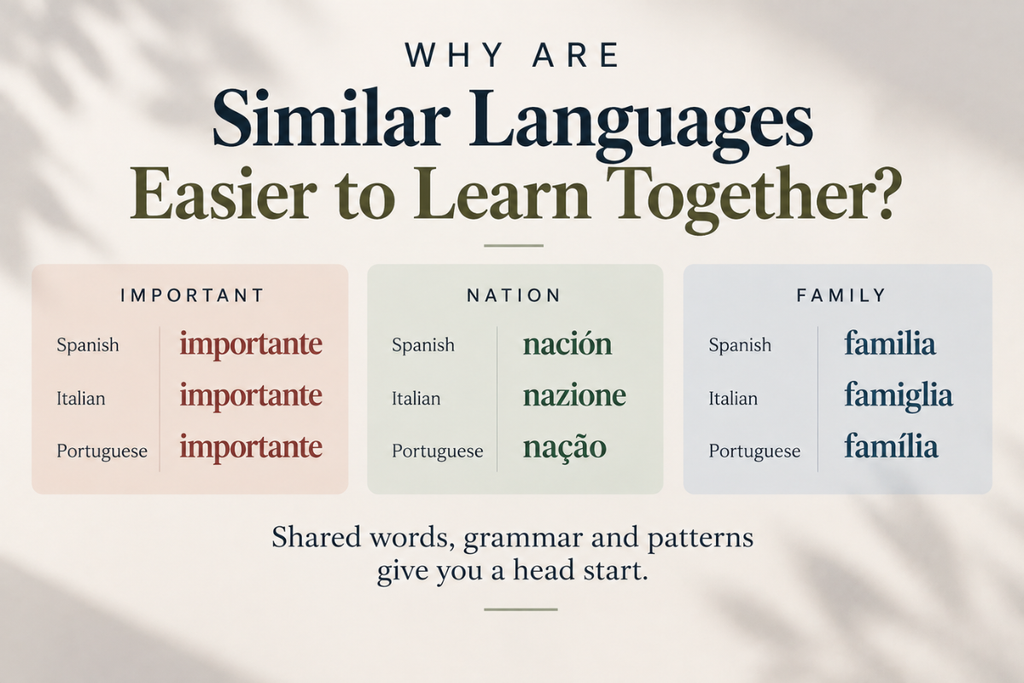
Why Are Similar Languages Easier to Learn Together?
Similarity gives you something to work with from the beginning.
If you already know Spanish and start learning Italian, you will probably recognize many words before you have formally learned them. You may also notice familiar grammatical ideas and sentence patterns.
For example, someone who knows Spanish may recognize the relationship between words such as importante and importante in Italian, or nazione and nación.
The exact vocabulary, pronunciation, and grammar are not always the same, but the similarities can give you useful clues.
The same thing happens between Portuguese and Spanish.
This can make reading especially interesting. You may be able to understand the general meaning of a sentence even when you have never studied every word in it.
That existing knowledge can reduce the amount of completely new material you have to process.
However, recognizing something is not the same as being able to use it correctly.
That distinction becomes important when you study similar languages together.
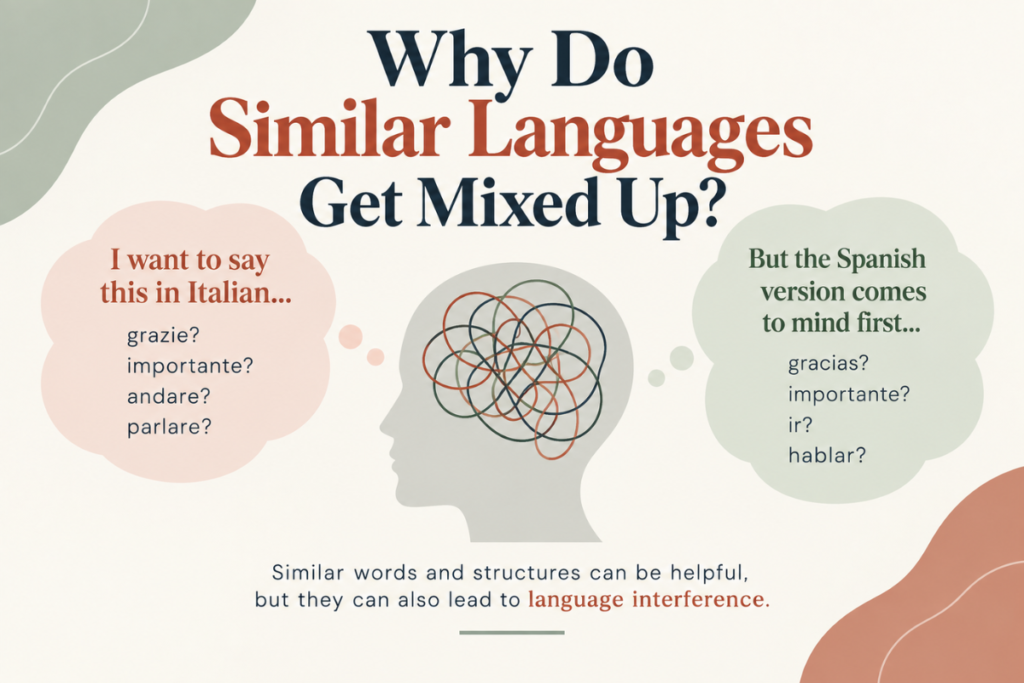
Why Do Similar Languages Get Mixed Up?
Your brain naturally looks for patterns.
When two languages contain similar words and structures, it is easy to reach for something familiar instead of retrieving the correct form from the language you are currently using.
This can happen with vocabulary, pronunciation, verb endings, gender, prepositions, sentence structures, and expressions.
Imagine that you know Spanish and are learning Italian. You want to say something in Italian, but the Spanish version comes to mind first. Because the two languages are related, the Spanish word may feel close enough to the Italian one that you use it without noticing.
Sometimes the result is understandable. Sometimes it is completely wrong.
This is one reason similar languages can produce persistent mistakes. The problem is not always that you do not know the correct word. You may know it perfectly well and still retrieve the wrong one.
That is language interference.
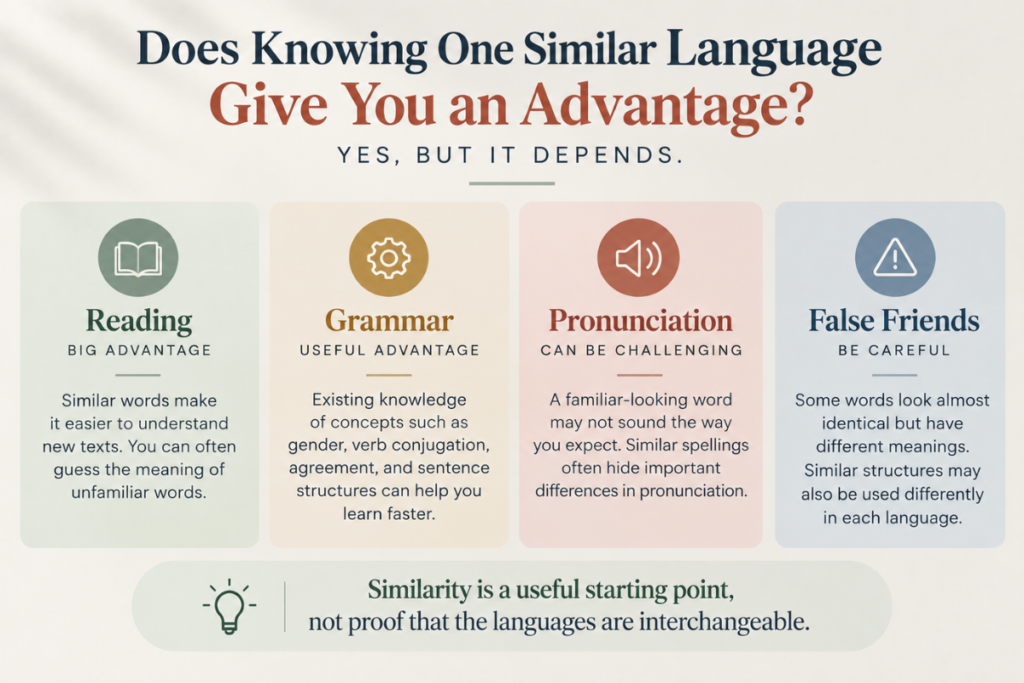
Does Knowing One Similar Language Give You an Advantage?
Yes, but the advantage depends on the skill and the language pair.
Reading may benefit very quickly from similarities in vocabulary. You can often guess the meaning of unfamiliar words because they resemble words you already know.
Grammar can benefit too. If you already understand concepts such as gender, verb conjugation, agreement, or particular sentence structures, you may not be learning those concepts from zero.
However, pronunciation can be a different story.
A familiar-looking word may not sound the way you expect. A similar grammatical structure may be used differently. A word that looks almost identical may have a different meaning.
This means your existing language can help you understand the new language while also encouraging incorrect assumptions.
That is why similarity should be treated as a useful starting point, not as proof that the languages are interchangeable.
What Happened When I Learned Spanish, Italian, and Portuguese?
I experienced this myself when I tried learning Italian and Portuguese after learning Spanish.
The similarity was genuinely helpful. I could recognize a lot of vocabulary, understand the general meaning of sentences, and notice grammatical relationships more quickly than I would have in a completely unrelated language.
But that same familiarity caused interference.
Sometimes I would know what I wanted to say but reach for the Spanish word or structure because it was already established in my mind. Portuguese was particularly interesting because it could look very familiar while still behaving differently from Spanish.
Italian created similar situations.
The languages gave me a head start, but they also made it necessary to pay attention to differences that I might have ignored if the languages were completely unrelated.
That experience changed how I think about learning related languages.
The goal is not to pretend that the languages are completely separate. The similarities are useful. The important thing is to become increasingly aware of the differences.
Can You Learn Spanish and Portuguese Together?
Yes, but you should expect some interference.
Spanish and Portuguese share a large amount of vocabulary and have many similarities in grammar. This can make it tempting to translate directly between them.
That approach can work for understanding the general meaning, but it becomes risky when you are trying to produce natural Portuguese or Spanish.
You may recognize a Portuguese word because it resembles Spanish. You may even guess its meaning correctly. But pronunciation, spelling, gender, prepositions, verb forms, and everyday expressions can still differ.
For that reason, learners should pay particular attention to words and structures that look similar but are used differently.
These differences are often more important than the obvious similarities.
Can You Learn Spanish and Italian Together?
The same basic principle applies to Spanish and Italian.
The similarities can make vocabulary and grammar easier to approach, especially at the beginning. You may also find that reading gives you a sense of progress quite quickly.
Speaking can be more complicated.
When you are trying to produce language quickly, your brain does not always have time to compare every word with the correct language. A familiar Spanish word can appear while you are speaking Italian, or the other way around.
This usually becomes less of a problem as your experience with each language grows.
The more clearly you associate certain words, expressions, sounds, and structures with one particular language, the easier it becomes to retrieve them correctly.
Is Language Mixing a Sign That You Are Failing?
Not necessarily.
Mixing similar languages is often a normal part of learning them.
If you are actively building two language systems that contain overlapping vocabulary and structures, some interference is expected. The fact that you occasionally use the wrong word does not mean that you cannot learn both languages.
What matters is what happens over time.
If you notice the same mistake repeatedly, that mistake is useful information. It tells you where the two languages are competing in your memory.
Instead of simply memorizing the correct answer again, pay attention to the difference between the two forms.
For example, if you repeatedly confuse two similar words, learn them together and deliberately compare their meanings and usage. Seeing the contrast can be more useful than studying each word in isolation.
How Can You Keep Similar Languages Separate?
You do not need an elaborate system.
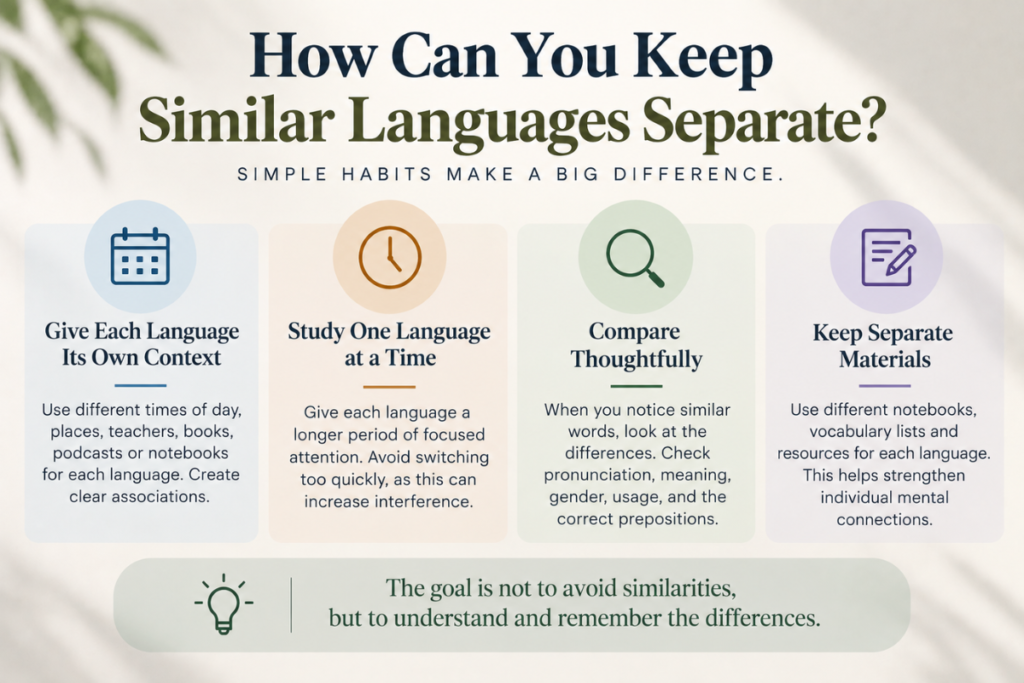
One useful approach is to give each language its own context.
You might read Italian in the morning and Portuguese in the evening. You could use different teachers, books, podcasts, or notebooks for each language. The exact arrangement is less important than creating clear associations.
It also helps to spend time using each language on its own.
If you study Spanish for twenty minutes and then immediately switch to Italian, you may notice more interference than if you give each language a longer period of focused attention.
Another useful habit is comparison.
When you notice that two languages have similar words, do not simply think, “These are basically the same.”
Ask yourself how they are actually different.
Is the pronunciation different? Does the word have the same meaning? Is the gender different? Is the expression used in the same situations? Does the verb take the same preposition?
Those small differences gradually become easier to remember.
Should You Learn Similar Languages at the Same Time?
There is no universal reason to avoid it.
Your decision should depend on your available time, your goals, your existing level, and how much attention you can give each language.
If you are already advanced in one language and want to start another related language, the first language can provide a useful foundation.
If you are a beginner in both, the situation can be more demanding because you do not yet have a strong system in either language. You may have more trouble remembering which forms belong to which language.
In either situation, you can reduce the problem by giving each language enough regular exposure and by paying attention to the differences.
You also do not have to give both languages equal priority.
One can be your main language while the other receives less study time. This can be a much easier arrangement than trying to progress equally in several languages at once.
How Long Does It Take to Stop Mixing Similar Languages?
There is no fixed amount of time.
It depends on the languages, your existing knowledge, how often you use them, and how much meaningful exposure you get.
At first, mixing may happen frequently because the new language has not yet developed strong independent associations.
With more use, the languages gradually become more distinct in your mind.
You start remembering that a particular expression belongs to one language. You recognize that a familiar-looking word has a different pronunciation. You become more sensitive to the grammar and rhythm of each language.
Eventually, the similarities are still there, but they cause less confusion.
That separation comes through experience rather than simply memorizing a list of differences.
Key Takeaways
→ Similar languages can be easier to learn because they share vocabulary, grammar, and other features.
→ The same similarities can cause interference when you try to speak or write.
→ Recognizing a word does not mean you can use it correctly in the other language.
→ Comparing similar words and structures can help you notice important differences.
→ Giving each language its own context can make them easier to keep separate.
→ You do not need to avoid related languages simply because they can be confusing.
→ With enough exposure and use, the languages usually become easier to distinguish.
Learning similar languages together can certainly be confusing at times. But that confusion is not necessarily a reason to stop. The similarities give you something to build on, while the differences give you something to learn.
The more experience you gain with each language, the less you have to consciously separate them. Eventually, what initially felt like one large group of similar words and structures starts becoming two distinct languages in your mind.