
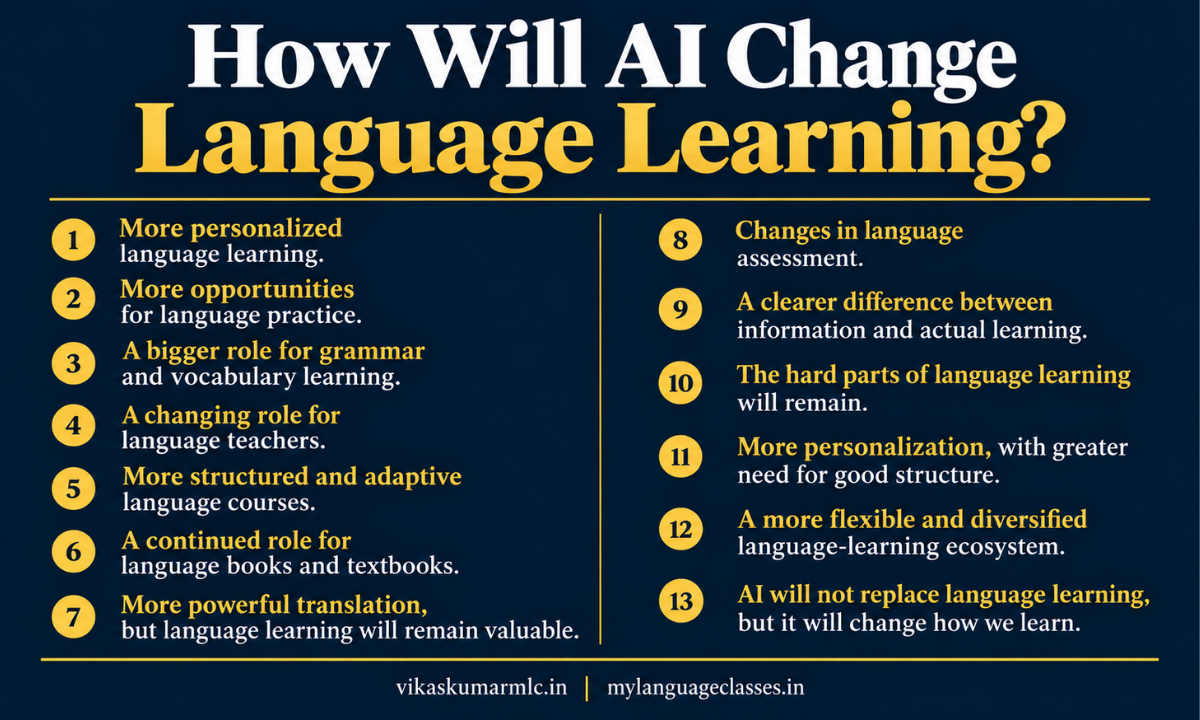
How Will AI Change Language Learning?
How AI Will Change Language Learning is a question I have been thinking about for some time. As a language educator and founder of My Language Classes, I have watched technology change how learners find lessons, practice grammar, study vocabulary, and access explanations.
AI takes that change much further.
The important question is not whether learners will use AI. They already are. The more useful question is what AI will actually change about the process of learning a language.
I expect major changes in how learners practice, how teachers prepare lessons, how courses are designed, and how learning materials are produced. I also expect some parts of language learning to remain surprisingly difficult.
AI can explain a grammar rule in seconds. It can generate hundreds of examples. It can create a reading passage for a specific level. It can correct writing and produce additional practice based on an error.
That changes the availability of learning support.
It does not automatically change how human learning works.
This distinction matters. A learner can receive a perfect explanation and still forget the rule. A learner can generate unlimited vocabulary exercises and still struggle to retrieve words during real communication. A learner can have an AI conversation every day and still develop gaps in grammar, comprehension, or natural language use.
My predictions therefore focus less on what AI can do today and more on what its growing capabilities could mean for language education.
I expect AI to make personalized learning far more accessible. I expect practice material to become almost unlimited. I expect the role of teachers to change, rather than simply disappear. I expect language courses and books to become more valuable when they provide structure that AI-generated content cannot easily provide on its own.
I also expect learners to become much more demanding.
Once people become accustomed to asking a system for an explanation at exactly their level, generating examples about topics they care about, or receiving immediate feedback, they will expect traditional learning products to provide a clear reason for their existence.
That will affect language schools, course providers, textbook publishers, teachers, and learners.
My own work has also shaped how I see this issue. Through My Language Classes, I work across English, Spanish, and Japanese learning and create books, courses, and other structured learning resources. I have also explored these questions in Language Learning in the Age of AI, How Language Learning Really Works, and The Role of Communication in Language Learning.
So, when I look at AI in language education, I am not looking only at the technology. I am looking at what happens when that technology meets the realities of teaching and learning languages.
That is where I think the most interesting changes will happen.
AI Will Make Personalized Language Learning Much More Accessible
One of the biggest changes I expect from AI is the wider availability of personalized language learning. Personalization has always been useful, but providing it at scale has been difficult for teachers and language programs.
A teacher can adjust an explanation for one student. A good teacher can also change an exercise when a student is struggling. The difficulty comes when one teacher has dozens of learners, each with different vocabulary, grammar knowledge, interests, and learning gaps.
AI can reduce that problem considerably.
A learner studying Spanish could ask for an explanation of the Spanish preterite using simple English. Another learner could ask for the same grammar point through more advanced examples. A third learner could request exercises focused only on the mistakes they repeatedly make.
The underlying topic remains the same, but the learning material can change around the learner.
This matters because language learners rarely have identical needs. One beginner may need more work on basic sentence structure. Another may understand grammar well but have limited vocabulary. Someone at an intermediate level may know thousands of words but still struggle to produce accurate sentences quickly.
Traditional language courses usually have to make reasonable assumptions about these differences. AI can respond to them individually.
I expect this to affect grammar learning particularly strongly. Learners will increasingly be able to ask for explanations at different levels, request additional examples, compare similar structures, and generate targeted practice without waiting for a teacher to prepare new material.
The same applies to vocabulary. Instead of studying a fixed list, learners can ask for examples related to their work, interests, travel plans, or current level. AI can also reuse words in new contexts, which can make repeated exposure easier to organize.
However, I do not think personalization itself guarantees better learning.
There is a difference between personalized content and personalized learning. Giving someone material that matches their interests is relatively easy. Knowing what that learner should study next is much harder.
A system can generate a hundred exercises on a grammar point. That does not mean the learner needs all one hundred. It may be more useful to identify why the learner keeps making the same error and choose a smaller amount of targeted practice.
This is where human judgment and structured learning remain important.
At My Language Classes, for example, our English, Spanish, and Japanese resources are organized around defined learning goals rather than unlimited content. A structured book or course gives learners a path through the material. AI can increasingly adapt that material around the learner, but the underlying sequence still needs thoughtful design.
I therefore expect the future to involve both.
AI will make personalized language-learning support far more accessible. Good teachers, courses, and books will still provide the structure that helps learners decide what deserves their attention.
AI Will Make Language Practice Almost Unlimited
One of the clearest changes I expect is the amount of language practice learners can access. Creating good practice material takes time, especially when exercises need to match a learner’s level and specific weaknesses.
AI changes that equation.
A learner can request additional grammar questions after finishing a lesson. They can ask for new vocabulary exercises using words they have recently studied. They can generate reading passages at a particular level and then ask for comprehension questions based on those passages.
The same principle applies to writing and translation practice. A learner can receive a prompt, produce an answer, identify areas for improvement, and generate another task targeting the same problem.
This could make practice far more available than it has been in the past.
I expect AI-generated language exercises to become a normal part of self-study. Learners will not always need to search for another worksheet or wait for a teacher to prepare additional material.
This could be especially useful for learners working with grammar. Suppose someone is studying Spanish object pronouns and keeps confusing direct and indirect objects. An AI system can create examples that focus specifically on that distinction.
The learner can then increase or reduce the difficulty as needed.
The same approach works with English tenses, Japanese particles, Spanish verb conjugations, vocabulary usage, sentence structure, and many other areas. The potential range is enormous because the system does not have to rely on a fixed set of exercises.
However, unlimited practice creates its own problem.
More exercises do not automatically produce more learning.
A learner who completes 500 poorly chosen questions may learn less than someone who completes 50 well-designed questions with careful review. Practice has value when it addresses a meaningful learning objective and gives the learner a reason to retrieve and use the language.
This is why I do not think AI will eliminate the need for structured learning materials.
A resource such as Language Learning in the Age of AI can help learners understand where AI fits into their learning process. A structured language book can establish what should be learned and in what order. AI can then provide additional practice around that structure.
I expect this combination to become increasingly common.
The basic learning material establishes the path. AI provides additional practice when the learner needs it.
That distinction will matter as AI-generated content becomes easier to produce. The problem will gradually shift from finding enough material to deciding which material is actually worth using.
AI Will Change How Learners Learn Grammar and Vocabulary
Grammar and vocabulary are two areas where AI can make language learning feel very different. Both already have large amounts of available material, but access to material is only part of the problem.
The bigger issue is whether learners can get the right explanation and practice at the right time.
A learner may understand a grammar rule but still make the same mistake repeatedly. Another learner may know the rule but struggle to understand why a particular sentence uses one form instead of another. AI can respond to these differences immediately.
For grammar, learners can ask for simpler explanations, additional examples, comparisons between similar structures, or exercises focused on one specific problem. They can also ask the system to explain an error instead of simply providing the correct answer.
This could change how learners approach difficult grammar topics.
Instead of searching through several websites for an explanation, a learner can describe the exact problem and request an explanation suited to their level. The response can then be followed by examples and targeted practice.
Vocabulary learning can change in a similar way.
A learner can ask for examples of a new word in different contexts. They can request sentences related to their profession, interests, or current level. They can also generate exercises that require them to recall the word rather than simply recognize it.
That last distinction is important.
Recognizing a word when reading is different from retrieving it when writing or speaking. AI can create activities that target both forms of knowledge, but the learner still has to do the mental work of remembering and using the language.
I also expect AI to make comparison-based learning more accessible. Learners often struggle with pairs or groups of forms that look similar, such as English past simple and present perfect, Spanish ser and estar, or Japanese particles such as は and が.
A learner can ask for carefully controlled comparisons and examples that highlight the difference.
However, I would be cautious about treating AI explanations as automatically reliable. A fluent explanation can still contain an error, miss an important exception, or simplify a rule too much.
This is one reason I continue to see value in carefully structured language resources. A well-designed grammar book provides a stable reference point, while AI can provide additional explanations and practice around it. My own Complete English Tenses Mastery Guide follows that structured approach for English grammar, while AI can potentially give learners more individualized practice around those concepts.
The same principle applies across Spanish and Japanese.
AI can make grammar and vocabulary instruction more flexible. It can make practice more responsive. It can also make explanations easier to access.
What it cannot do by itself is turn an explanation into permanent knowledge.
Learners still need repeated exposure, retrieval, meaningful use, and enough time for the language to become easier to access. That part of language learning is likely to remain important even as the technology around it changes.
AI Will Change the Role of Language Teachers
I do not expect AI to remove language teachers from education. I do expect it to change what teachers spend their time doing.
For many years, teachers have had to handle tasks that require considerable preparation. They create exercises, explain grammar, prepare examples, adapt materials, correct writing, and plan lessons for learners with different abilities.
AI can assist with many of these tasks.
A teacher can use AI to create several versions of an exercise. The same grammar point can be presented through simpler examples for beginners or more demanding examples for advanced learners. Teachers can also generate supplementary material when a class needs more practice with a particular topic.
This can reduce preparation time.
The more important change, however, may be what teachers do with the time that becomes available.
A teacher’s value does not come only from knowing grammar or producing worksheets. Good teaching requires judgment. A teacher has to recognize patterns in learner errors, decide what deserves attention, determine when a learner is ready to move forward, and choose an explanation that makes sense to that particular student.
AI can provide information about a language. It has a harder problem to solve when it comes to deciding what a particular learner actually needs.
Consider a student who repeatedly makes the same grammar mistake. The obvious response may be another explanation of the rule. An experienced teacher may notice that the real problem is something else, such as weak vocabulary, confusion between two structures, limited exposure, or difficulty retrieving the form quickly.
That diagnosis can change the entire lesson.
I expect this diagnostic role to become more important as AI takes over more routine teaching tasks.
Teachers may spend less time creating basic exercises and more time reviewing learner performance, designing learning sequences, giving targeted feedback, and helping students use language in meaningful situations.
This could also change how language classes are organized.
A teacher might use AI-generated material for individual practice while spending class time on activities that require human interaction, discussion, interpretation, and sustained communication. The technology could handle some repetitive preparation while the teacher focuses more closely on the learner.
That does not mean every teacher will use AI well.
There will be a learning curve. Teachers will need to judge the quality of AI-generated explanations and exercises. They will also need to recognize when an AI response is technically correct but pedagogically unsuitable.
This is particularly important in language education because a correct answer is not always a sufficient teaching answer.
A beginner may need a simple explanation. An advanced learner may need a precise distinction. Two learners can make the same mistake for completely different reasons.
The teacher still has to make that judgment.
My view is that AI will therefore raise the standard for good language teaching. Routine content production will become easier, but thoughtful teaching will become more visible.
This is one reason I see a continued role for structured education through My Language Classes. Our work across English, Spanish, and Japanese is built around teaching and learning resources, but the value of those resources ultimately depends on how well they support the learner’s actual needs.
AI will change the tools teachers use.
It may change the tasks they perform.
It may even change what learners expect from them.
But I expect the strongest teachers to remain important because language learning involves judgment, feedback, interaction, and human understanding that cannot be reduced to generating another exercise.
AI Will Change What Learners Expect From Language Courses
Language learners have always expected courses to explain things clearly and help them make progress. AI is likely to raise those expectations considerably.
When learners can ask an AI system for an explanation at any time, they may become less willing to accept a course that gives everyone the same explanation. They will expect examples that match their level, practice that addresses their weaknesses, and answers that respond to their specific questions.
This could change the meaning of a language course.
A course will have to offer more than a collection of lessons. Learners will increasingly want a clear learning path, sensible progression, reliable explanations, useful practice, and some way to understand whether they are actually improving.
AI can generate content quickly. It cannot automatically decide what belongs in a coherent curriculum.
That distinction matters.
Imagine a learner studying Spanish. AI can generate exercises on verb conjugation, vocabulary, sentence formation, or reading comprehension within seconds. It can also change the difficulty whenever the learner asks.
But the learner still needs to know what should be studied first, what can wait, which errors matter most, and when a particular topic has been learned well enough to move forward.
That is where structured courses can retain their value.
I expect learners will increasingly use AI alongside courses rather than choosing one or the other. The course can provide the sequence and objectives, while AI can provide additional explanations, examples, and practice whenever the learner needs them.
This model is particularly relevant to the way we build resources at My Language Classes.
For example, The Complete Spanish DELE A1 Course: Grammar, Vocabulary and Practice Tests provides a defined preparation structure for learners working toward Spanish DELE A1. A learner can use AI to create additional examples or review difficult concepts, but the course gives that learner a clear body of material to work through.
I expect this relationship to become more common across language education.
The strongest courses may become less concerned with producing an enormous amount of content. Instead, they may focus more carefully on what learners should study, in what order, and why each part matters.
AI will make content easier to produce.
That could make good curriculum design more valuable, because learners will have more material available than they can possibly use.
There is another change I expect.
Learners may become less patient with courses that hide their structure. They will want to understand what they are learning, what comes next, and how each lesson connects to their larger goal.
This could push language education toward clearer learning outcomes and better-designed progression.
I do not think this means every course needs an AI chatbot built into it. That would reduce the issue to a technology feature.
The deeper change is that learners will increasingly compare traditional courses with an environment where explanations, examples, and practice can be generated on demand.
A good course will need to justify its structure.
It will need to show why its sequence works, why its materials are worth using, and what learners gain from following that particular path.
In that sense, AI may make language courses more demanding to build, even while making individual learning activities easier to produce.
AI Will Change the Role of Language Textbooks and Learning Books
I think books will remain part of language learning, but their role will change as AI becomes better at generating explanations, examples, and exercises.
For a long time, a good language book has had to anticipate the questions a learner might have. It has had to explain a concept clearly, provide useful examples, organize practice, and move the learner from one topic to the next.
AI can now handle some of those tasks on demand.
A learner can ask for another explanation of a grammar rule. They can request simpler examples, more difficult examples, additional exercises, or a comparison with another structure. They can even ask for material built around a particular vocabulary set.
That creates pressure on traditional books.
A poorly designed book may become less useful when a learner can generate similar explanations instantly. If a book mainly provides isolated explanations and exercises without a clear learning structure, AI can reproduce much of that experience at very little cost.
I think this will create a sharper distinction between content and curriculum.
Content can be generated quickly.
A good curriculum requires decisions about what learners should study, what they can postpone, how concepts connect, and how difficulty should increase. Those decisions require knowledge of the language and an understanding of how learners develop.
This is where I think well-designed language books will continue to have an important role.
A strong book gives the learner a stable reference point. It does not change its explanation every time the learner asks a new question. It presents a carefully selected scope, sequence, terminology, examples, and practice system.
AI can then sit alongside that structure.
For example, a learner using my Complete English Tenses Mastery Guide can use AI to generate additional sentences or ask for more practice with a particular tense. The book still provides the organized framework through which the learner studies the twelve tense forms.
The same principle applies to my Spanish and Japanese resources. A learner studying Spanish grammar or Japanese particles can use AI for additional explanations while relying on a structured resource for systematic coverage.
I expect this combination to become increasingly common.
Books may become less important as the only source of practice. They may become more important as carefully edited foundations around which other forms of practice are built.
There is also a quality issue that I think will become increasingly important.
AI can generate thousands of language examples, but quantity does not guarantee quality. A language-learning book has to make deliberate choices about which examples are useful, which distinctions matter, and which explanations are appropriate for the intended learner.
That editorial judgment has real value.
This is one reason I do not think AI will simply make language-learning books obsolete. I think it will make weak books easier to replace while putting more pressure on good books to demonstrate why their structure and content deserve a learner’s time.
At My Language Classes, this is already relevant to how I think about English, Spanish, and Japanese learning resources. The purpose of a book should not be to compete with AI at generating endless material.
Its purpose should be to give learners something worth building their learning around.
AI Will Make Translation Less Important for Some Learners, but It Will Not Make Language Learning Unnecessary
AI translation may have one of the biggest practical effects on language learning. If machines can translate conversations, messages, documents, and other content with increasing accuracy, some people may question whether learning another language is still necessary.
I think that question will become more common.
For many practical situations, translation can already solve a communication problem. A traveler may need directions. A customer may need to understand a message. A professional may need to read information written in another language.
In these situations, technology can reduce the need to learn the language from scratch.
That does not mean translation provides the same experience as knowing the language.
There is an important difference between getting the meaning and understanding the language yourself.
When you know a language, you can recognize tone, ambiguity, humor, cultural references, and subtle changes in meaning without depending on an intermediary. You can also participate directly rather than waiting for another system to interpret the exchange.
This matters even more in personal relationships.
People learn languages because they want to communicate with family members, friends, colleagues, students, customers, or communities. A translation system can transfer words between languages, but it does not create the same connection that comes from understanding someone directly.
There is also a difference between consuming translated information and being able to access the original language.
A translated Spanish article may give you the main information. Reading it in Spanish gives you access to the writer’s actual choices of words, tone, structure, and cultural references. The same applies to Japanese literature, English media, academic writing, and everyday communication.
I therefore expect AI translation to change the reasons people learn languages more than it changes the need to learn them.
Some people will decide that basic functional language ability is enough because translation can handle situations they previously needed to study for. Others will continue learning because they want direct access to the language.
This could also change the goals of language learners.
Someone may no longer need to learn a language simply because they need to order food, understand a basic document, or communicate during occasional travel. They may instead learn because they want deeper access to a culture, profession, community, or relationship.
That could make language learning more intentional.
I also think translation technology could expose an important difference between communication and language ability. If a machine can transmit the basic meaning, learners may have to think more carefully about why they want to develop the ability themselves.
This question has been central to my thinking about language education and is also why I wrote The Role of Communication in Language Learning. Communication is more than transferring information from one person to another. Language shapes how people express ideas, interpret meaning, and participate in social interaction.
For that reason, I do not believe better AI translation will make language learning irrelevant.
It may remove some practical pressure to learn a language. It may also make certain forms of communication much easier.
But for people who want to understand and use a language directly, the reason for learning will remain. AI may change the motivation, the methods, and the tools, while the value of knowing another language continues to exist.
AI Will Change Language Assessment
Assessment is one area where AI could force language education to rethink some long-standing practices. When AI can produce grammatically correct sentences, write essays, translate passages, and respond to prompts within seconds, simply asking learners to produce written language becomes less informative.
This does not make assessment less important. It makes good assessment more important.
Traditional language tests often ask learners to demonstrate specific knowledge under controlled conditions. That approach still has value, especially when the goal is to measure grammar, vocabulary, reading, or writing ability.
The difficulty becomes greater when the same tasks can be completed with substantial AI assistance outside the testing environment.
I expect language assessment to move toward tasks that make individual ability easier to observe. This could include supervised writing, spontaneous responses, interactive tasks, oral assessments, reading comprehension, and activities that require learners to respond to changing information.
The goal should not be to create assessments that are impossible to use with AI. That would be difficult to maintain as technology develops.
The better approach is to decide what the assessment is actually trying to measure.
If the goal is to measure independent language ability, the conditions should make that ability visible. If AI assistance is allowed, the assessment should instead measure how effectively the learner can use AI while still demonstrating meaningful language knowledge.
That distinction could lead to very different forms of assessment.
For example, a writing task might ask learners to produce a response independently before reviewing it with an AI system. The learner could then explain which suggestions they accepted, which they rejected, and why.
Such a task would measure more than writing accuracy. It could also reveal whether the learner understands the language well enough to evaluate the correction.
I think this ability will become increasingly important.
AI can provide an answer, but learners still need to judge whether that answer is appropriate. A learner who accepts every correction without understanding it may produce better-looking language without actually improving their language ability.
This creates a new assessment question:
Can the learner use AI without becoming dependent on it?
Language education may eventually need to measure both independent language ability and responsible AI-assisted language use.
This will affect language certification as well.
Exams such as the DELE and JLPT have different structures and objectives, but the broader issue is the same. As AI becomes more capable, exam designers will need to keep asking whether their tasks measure the ability they claim to measure.
For learners preparing through My Language Classes, this distinction matters because preparation should not become a process of producing answers that look correct. A learner preparing for Spanish DELE A1, for example, still needs to develop the underlying grammar, vocabulary, reading, and communication skills that the exam is designed to assess.
I expect assessment to become more varied as AI develops.
Some traditional testing methods will remain useful. Others will need modification. More importantly, educators will have to become clearer about the difference between producing correct language and demonstrating actual language ability.
AI will make that distinction much harder to ignore.
AI Will Make the Difference Between Information and Learning More Important
I think this will be one of the most important changes in language education. AI will make language information so easy to access that simply finding an explanation will become almost meaningless as a measure of learning.
A learner can already ask AI to explain a grammar rule, translate a sentence, define a word, create examples, or generate a practice exercise. The response can arrive immediately and can often be adjusted to the learner’s level.
That is useful.
But access to an explanation is not the same as learning.
A learner can read an excellent explanation of the Spanish past tense and still fail to use it correctly later. A learner can ask for the meaning of a Japanese particle several times and still confuse it in actual sentences. A learner can understand an English grammar rule while reading and still make the same mistake when writing.
The missing element is learning itself.
Language knowledge develops through processes that require more than receiving information. Learners need to notice patterns, understand meaning, retrieve information, use it, receive feedback, and encounter the same language repeatedly.
AI can support many of these processes. It cannot simply perform them on behalf of the learner.
This distinction becomes especially important when AI makes learning feel productive.
Generating twenty exercises can feel like studying. Reading a detailed explanation can feel like studying. Asking AI to correct every sentence can feel like studying.
The learner may still have difficulty producing the language without assistance.
I expect this problem to become more visible as AI becomes better.
When material becomes extremely easy to generate, learners will have more opportunities to confuse activity with progress. They may spend hours interacting with language without developing the specific abilities they actually need.
This is why I think structured learning will become more important alongside AI.
A learner needs to know what they are trying to develop. They need to know which concepts matter at their current level. They need opportunities to retrieve those concepts without assistance. They also need to see whether they can use them in a new context.
This is one reason I have spent so much time thinking about these questions in How Language Learning Really Works.
The central problem in language education has never been a simple shortage of information. Learners have had access to dictionaries, textbooks, teachers, courses, videos, and online resources for years.
The harder problem has always been turning exposure and information into usable knowledge.
AI can reduce the effort required to find information dramatically. It can also create new opportunities for practice and feedback.
But the learner still has to learn.
That means the future of language education may place greater emphasis on the difference between content consumption and actual learning.
Teachers will need to help learners recognize that difference. Course designers will need to build around it. Books will need to provide structure rather than simply more information.
Most importantly, learners will need to become better at judging whether their study activities are producing lasting language ability.
AI can make learning support easier to access.
It may also make it easier to avoid the difficult parts of learning.
I think recognizing that difference will become one of the most important skills for language learners in the years ahead.
AI Will Not Remove the Hard Parts of Language Learning
AI can make many parts of language learning easier, but I do not expect it to remove the underlying difficulty of becoming proficient in another language.
Learning a language requires the brain to build connections between sounds, words, structures, meanings, and situations. Those connections become more accessible through repeated exposure and use.
AI can make that exposure and use easier to arrange.
It cannot simply transfer the knowledge into the learner’s memory.
A learner still has to encounter vocabulary enough times to remember it. Grammar still has to become familiar through repeated use. Reading still requires the ability to process sentences and connect ideas. Listening still requires real-time comprehension.
Speaking has its own demands.
A learner may know exactly how to form a sentence when given enough time. Producing that sentence quickly during a conversation is different. The learner has to retrieve vocabulary, select grammatical forms, interpret the other person’s words, and construct a response while the interaction continues.
AI can provide conversation practice. It can create useful scenarios and respond immediately.
The underlying processing still has to happen in the learner.
This is why I am cautious about predictions that AI will make language learning dramatically faster for everyone.
It may reduce wasted time. It may provide better explanations. It may give learners more practice. It may help them identify problems earlier.
Those are significant advantages.
However, reducing friction around learning is different from eliminating the time required to develop a skill.
The same applies to vocabulary.
AI can generate a personalized list of words in seconds. It can provide examples, translations, definitions, and exercises. The learner still needs to encounter those words repeatedly and retrieve them successfully across different contexts.
The technology can support the process.
The process itself still has to happen.
I also expect language maintenance to remain difficult. Learning a language is one challenge. Keeping it active when it is rarely used is another. AI may make maintenance easier by providing accessible practice, but regular engagement will still matter.
This is where I think some of the biggest claims about AI and language learning need to be treated carefully.
Better technology can improve the conditions for learning without changing every underlying requirement of learning.
A well-designed AI tool can help a learner practice more efficiently. A good teacher can identify a problem that the learner has not noticed. A structured book can provide a logical sequence. A course can establish progression and accountability.
These resources can complement one another.
At My Language Classes, this is one reason we continue to treat structured learning as important across English, Spanish, and Japanese. Books and courses give learners a defined path, while technology can provide additional ways to practice and review what they are learning.
I expect that relationship to become stronger as AI develops.
The difficult parts of language learning will remain, but learners may have better support while working through them.
That is a more realistic prediction than expecting AI to make language proficiency effortless.
My Biggest Prediction: Language Learning Will Become More Personalized, but Good Structure Will Become More Valuable
My biggest prediction is that AI will not make structured language learning less important. I think it will make good structure more valuable.
As AI gives learners access to almost unlimited explanations, examples, exercises, translations, and feedback, the problem will shift. The challenge will no longer be finding something to study. The challenge will be knowing what to study, when to study it, and whether it is actually helping.
This distinction matters.
A learner can ask AI to explain the Spanish past tense, generate fifty examples, create a vocabulary list, and produce a reading passage within minutes. Yet that learner may still struggle to use the past tense correctly a week later.
More content does not automatically create better learning.
I expect successful language learning systems to combine personalization with a strong underlying structure. AI can adapt the experience around the learner, while a curriculum can determine the progression.
That combination could be far more powerful than either approach alone.
For example, a structured Spanish course can establish which grammar concepts a beginner should learn first. AI can then provide additional explanations when a learner struggles with one of those concepts. It can generate more examples, change the difficulty, or create targeted practice.
The structure provides direction.
The AI provides flexibility.
I think the same principle will apply to books. A strong language-learning book will not become irrelevant simply because AI can generate similar information. Its value will increasingly come from organization, progression, selection, and instructional judgment.
This is also why I believe my work on How Language Learning Really Works will remain relevant as AI becomes more capable. Understanding how learning happens will matter even more when learners have access to an enormous amount of technology.
The future I see is not AI replacing structured language learning.
It is AI making structured learning more adaptive.
That difference may shape the next generation of language courses, books, and learning platforms.
What I Expect Language Learning to Look Like in the Next Few Years
I expect language learning to become less dependent on a single resource. Learners will increasingly combine courses, books, AI tools, teachers, and independent practice according to their needs.
A learner may use a structured course to establish a foundation, a book to study a topic in depth, and AI to get additional explanations or practice. A teacher may become involved when the learner needs diagnosis, correction, guidance, or accountability.
This could make language learning more flexible without making structure unnecessary.
I also expect the distinction between different types of learning resources to become clearer. Some products will focus on instruction. Others will focus on practice, assessment, reference, or personalized support. AI will increasingly connect these different layers.
For learners, this could create a much more personalized experience.
For educators, however, it will create a higher standard.
Simply providing information will become less valuable when learners can ask AI for information instantly. Educators will need to offer stronger organization, better explanations, clearer progression, and a more thoughtful understanding of what learners actually need.
I expect language books to face a similar shift.
A book that simply presents information may struggle to justify its value when AI can explain the same information instantly. A well-designed book with a clear learning sequence, carefully selected examples, useful practice, and strong organization can still provide something important.
The same will be true for language courses.
A course cannot compete with AI simply by giving learners access to explanations. Its value will come from the structure and experience built around those explanations.
This is one reason I believe the future will not belong exclusively to AI tools or traditional learning resources. The strongest language-learning systems will probably combine both.
At My Language Classes, I see this as an opportunity rather than a threat. Our books and courses can provide structured learning, while AI can give learners additional flexibility around that structure.
The larger change will be that learners will have more control over how they learn.
That control will be useful, but it will also require better judgment. Learners will need to decide which explanations to trust, which resources to use, what to practice, and when they need human guidance.
In other words, AI may give learners more freedom.
The future of effective language learning may depend on knowing how to use that freedom well.
My Predictions for AI and Language Learning
My predictions about AI and language learning are ultimately quite simple. I do not think AI will make language learning disappear, and I do not think it will make teachers, books, or structured courses irrelevant.
I think it will change what each of them does.
→ AI will make personalized language support much more accessible.
→ Learners will have far more opportunities to practice grammar, vocabulary, reading, writing, and communication.
→ Language courses will need to offer stronger structure and clearer progression.
→ Language books will need to provide more than information. Their organization and instructional value will matter more.
→ Teachers will spend less time on routine explanations and more time on diagnosis, feedback, guidance, and higher-level learning decisions.
→ Translation will become even more powerful, but knowing a language will remain valuable for communication, understanding, relationships, and direct access to another culture.
→ Assessment will become more complicated because learners will increasingly have access to AI during the learning process.
→ The difference between consuming information and actually learning will become more important.
→ The basic work of language learning will remain. Learners will still need exposure, repetition, retrieval, comprehension, and meaningful use.
Most importantly, I think personalization and structure will become partners rather than competing ideas.
AI can adapt learning to an individual. A strong curriculum can give that learning direction. A teacher can provide judgment and human feedback. A book can provide a stable and carefully organized reference.
That combination interests me more than the idea of AI replacing everything that came before it.
My own book Language Learning in the Age of AI explores many of these questions from the perspective of someone working directly in language education. I expect these questions to become even more important as AI becomes a normal part of how people study languages.
The next few years will probably change language education significantly.
But the fundamental goal will remain the same: helping people understand and use another language with greater accuracy, confidence, and independence.
AI can change how we get there.
It cannot change what it means to actually know a language.
Leave a Reply